If you buy through our links, Amazon pays us a small commission at no extra cost to you. That’s how we keep the site running. How we choose.
Contents
pickleball edge guard tape comparison, in stock

PROLITE Pickleball Paddle - Edge Tape Armor


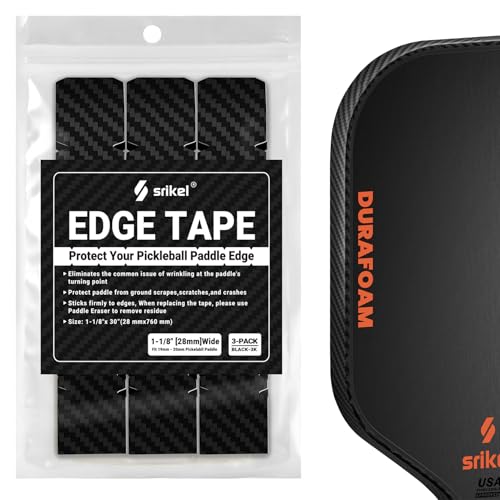


What edge guard tape does
Edge guard tape is an adhesive strip that wraps around the rim of the paddle. Its main job is protection: on dinks, very low balls and backhands near the ground, the edge scrapes the court, and on concrete or asphalt that wears and chips the original edge guard. On edgeless paddles, popular for their larger sweet spot, the core and face layers are more exposed, so tape makes even more sense there. It is also worth it on carbon fiber paddles, whose finish scuffs easily.
Weight, sweet spot and twist weight
All tape weighs something. A thin protective tape adds only a fraction of an ounce (a few grams) spread around the perimeter, but because it sits far from the center, you feel it more than the scale suggests:
- More stability on off-center hits: weight on the sides raises twist weight, the paddle's resistance to rotating when the ball misses the center. In practice, the sweet spot feels a bit larger.
- Slightly higher swing weight: if the tape covers the top, the paddle gets a little more head-heavy and gains power, at the cost of some hand speed in quick exchanges at the kitchen.
If you want to tune weight on purpose, the right tool is lead tape, which is usually applied under the edge guard tape so it stays put.
| Tape type | Protection | Added weight | Best use |
|---|---|---|---|
| Thin clear film | Moderate: prevents scuffs | Minimal | New paddles, keeping the look |
| Thick vinyl or PU tape | High: survives ground scrapes | Low | Outdoor courts, edgeless paddles |
| Pickleball-specific tape cut to width | High | Low | Quick, clean installation |
Widths and compatibility
The tape should cover the rim and fold a few millimeters onto each face. Since most cores are about 1/2 to 5/8 in (13-16 mm) thick, add the thickness of the faces plus the fold-over margin. Tapes made for pickleball already come in a suitable width; padel frame protectors are usually wider, designed for thick frames, and can creep too far onto the hitting surface. Measure your paddle's thickness before you buy.
Tip: if you play tournaments, don't let the tape cover a wide band of the face. The USA Pickleball rulebook sets out which modifications an approved paddle allows, so check the current version before an event.
How to apply it, step by step
- Clean the edge with isopropyl alcohol and let it dry completely.
- Start on one side near the throat, with the tape centered over the rim.
- Work slowly, stretching slightly around the curves; a hair dryer on low helps it conform.
- Fold the flaps onto the faces, press out any bubbles and finish on the opposite side with a clean cut.
- Wait a few hours before playing so the adhesive can set.
Common mistakes
- Applying it over a dusty or greasy edge: it lifts in the first session.
- Using electrical tape: it leaves glue residue and warps in the heat.
- Leaving wrinkles or bubbles on the top curve, exactly where it scrapes most.
- Stacking several layers to "protect more" and ending up with an unbalanced paddle.
Warning: tape will not fix a damaged paddle. If you notice cracks, a dented face or a different sound on contact, the paddle may be delaminated, and no tape can solve that.
To round out the protection, store it in one of our recommended paddle covers and see how to choose a paddle for how weight affects play. We compare spec sheets, the rulebook and verified reviews, but we do not physically test the products.
Frequently asked questions
What does pickleball edge guard tape do?
It protects the paddle's edge from scrapes and impacts against the court, especially on dinks and low balls on concrete. It is most useful on edgeless paddles and carbon fiber paddles, which scuff easily.
Does edge guard tape change paddle weight?
A little. It adds a few grams around the perimeter, which gives more stability on off-center hits and, if it covers the top, slightly more swing weight. For deliberate weight tuning, use lead tape.
Can I use padel frame protector tape on a pickleball paddle?
Sometimes, but it is not ideal. Padel protectors are usually wider because they are made for thick frames, and they can cover too much of the face. A pickleball-specific tape, or one that just covers the rim and folds a few millimeters, works better.
Is edge guard tape legal in tournaments?
It is widely used, but the USA Pickleball rulebook regulates paddle modifications. Keep the tape from covering a wide band of the face and check the current rules before competing.
You may also like
- ComparisonPickleball lead tapeLead or tungsten tape on a pickleball paddle: where to place it for stability or power, how many grams to add and whether it is legal. Tune your paddle right.
- ComparisonPickleball paddle coversPickleball paddle covers: neoprene sleeves or hard cases, sizes for standard or elongated paddles and ball pockets. Protect your paddle: pick the right fit.
- ComparisonPickleball grips and overgripsPickleball grips and overgrips: cushion or tacky, handle thickness, sweat, when to replace them and how to wrap one properly. Improve your hold: compare.
- ComparisonPickleball bags and backpacksPickleball bags and backpacks: how many paddles fit, a vented shoe compartment, a fence hook and whether a tennis bag will do. Compare and find yours.
- ComparisonCarbon fiber pickleball paddlesCarbon fiber pickleball paddles explained: what raw T700 carbon and thermoformed builds add, and when they beat fiberglass. Compare models and choose yours.
- GuideHow to Choose a Pickleball Paddle: Weight, Core and GripChoose a pickleball paddle without the guesswork: weight, 13 vs 16 mm core, carbon or fiberglass face, shape and grip size, plus a checklist for your profile.
- ComparisonCheap pickleball paddlesBudget pickleball paddles without the surprises: fiberglass vs wood, what wears out first and red flags to check before you buy. Spend less, but choose well.
- GuideBasic Pickleball Shots: Dink, Drive, Volley and Third ShotThe basic pickleball shots made simple: grip, return, drive, third shot drop, dink and volley, with a table of when to use each one and drills to practice.