If you buy through our links, Amazon pays us a small commission at no extra cost to you. That’s how we keep the site running. How we choose.
Contents
Our top 3 picks
Stock checked on October 7, 2026


pickleball paddles for beginners comparison, in stock
niupipo Pickleball Paddles Set of 2 or 4, USAPA Approved Fiberglass Pickleball Paddle Set with Balls and Bag…
niupipo Pickleball Paddles Set of 2 or 4, USAPA Approved Fiberglass Pickleball Paddle Set with Balls and Bag…
niupipo Pickleball Paddles Set of 2 or 4, USAPA Approved Fiberglass Pickleball Paddle Set with Balls and Bag…

niupipo Pickleball Paddles Set of 2 or 4, USAPA Approved Fiberglass Pickleball Paddle Set with Balls and Bag…

MTEN Pickleball Paddles Set of 2/4/1, USAPA Approved Fiberglass Rackets

MTEN Pickleball Paddles Set of 2/4/1, USAPA Approved Fiberglass Rackets

MTEN Pickleball Paddles Set of 2/4/1, USAPA Approved Fiberglass Rackets
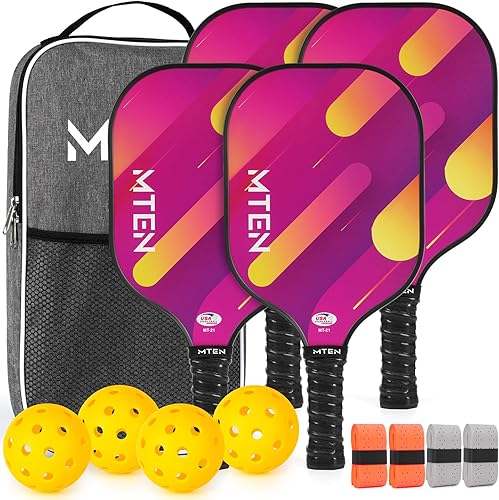
MTEN Pickleball Paddles Set of 2/4/1, USAPA Approved Fiberglass Rackets
PickleballPala score: combines the average rating and the number of buyer reviews on Amazon. No brand pays to be featured.
What a beginner paddle should have
When you are new, most of your shots will not land in the center of the paddle. That is why your first paddle does not need to be the most powerful or the most "pro" option. It needs to be the most forgiving: the ball should still go where you aim when you miss the sweet spot, and your arm should not be tired after the first hour.
The good news is that a beginner paddle does not need to be expensive. Budget and mid-range paddles with a polymer core and a fiberglass face are more than enough for your first months, and they leave you room to discover your playing style before you spend more.
Recommended specs
| Spec | Beginner recommendation | Why |
|---|---|---|
| Weight | midweight: 7.3-8.3 oz (207-235 g) | balance of control and power without straining the elbow |
| Core | polymer (polypropylene), 16 mm | more control, a stable sweet spot and less vibration |
| Face | fiberglass or composite | easy power and an affordable price |
| Shape | standard, about 16 x 8 in | the largest sweet spot |
| Grip | 4-4.25 in (10-11 cm) | easy to build up with an overgrip |
Weight and core: what you will notice most
A light paddle feels nice in the store, but on the court it passes on more vibration and makes you swing harder to reach the baseline. A heavy paddle adds power but punishes your elbow and gets to net volleys late. Midweight is the sensible starting point for almost everyone, including players who take up the sport for fitness or later in life.
A polymer honeycomb core is soft and quiet. At 16 mm thick, the ball stays on the face a split second longer, so it is easier to control soft shots like the dink into the kitchen, which is exactly what new players find hardest.
Materials: fiberglass yes, wood only to try the game
Fiberglass is the ideal beginner material: the face has a little spring and helps you get the ball over without big swings. Composite paddles that blend fibers are a good choice too. Carbon fiber is not a must at first; it makes more sense once you play often and want more control and spin (see our carbon fiber paddles guide).
Wooden paddles are the cheapest, but they are heavy and vibrate a lot. They are fine for trying the game at the beach or in a school gym, not for learning properly.
Tip: if two or more people are starting together, a paddle set with balls usually beats buying single paddles. Pick one with fiberglass paddles and polymer cores, not wood.
Shape and grip for your first paddle
A standard shape (about 16 x 8 inches) gives you the largest sweet spot and is the most forgiving on off-center hits. Elongated paddles add reach but demand more precision, so save them for later.
Most adults are comfortable with a grip circumference between 4 and 4.25 inches. If you are unsure, choose the smaller size: you can always build it up with an overgrip, but you cannot make it thinner. A grip that is too thick tires your forearm and limits your wrist.
Common mistakes when buying a first paddle
- Buying a premium paddle "so I never have to upgrade": without the technique, you will not benefit from it.
- Choosing the lightest paddle because it seems easier: it vibrates more and tires your arm.
- Buying a wooden set and quitting because "pickleball is not for me."
- Forgetting the balls: you need outdoor or indoor balls depending on where you play.
Heads up: very cheap paddles sometimes list specs or materials they do not actually meet. Check the weight, core thickness and verified reviews before you buy.
When to upgrade to a better paddle
Once you play several times a week, can control your dinks and feel your paddle is holding you back on control or spin, it is a good time to move up. Then check our full roundup of the best pickleball paddles. Until then, improving your technique pays off more than a new paddle: start with the basic pickleball shots.
We compare spec sheets, the official rules and verified reviews, but we do not physically test the products. Use the models above as a starting point and always confirm weight and dimensions on each listing.
Frequently asked questions
What pickleball paddle should a beginner buy?
A midweight paddle (7.3-8.3 oz) with a 16 mm polymer core, a fiberglass or composite face and a standard shape. It forgives off-center hits and is easy on your arm.
Is a wooden paddle good for beginners?
Only for trying the game briefly. Wooden paddles are heavy and vibrate a lot; if you plan to play regularly, a fiberglass paddle with a polymer core is much better and does not cost much more.
Do beginners need a carbon fiber paddle?
No. Carbon fiber adds control and spin, but new players barely notice the difference. It makes more sense once you play several times a week and have a solid soft game.
Should I buy a paddle set or a single paddle?
If two or more people are starting together, a set with paddles and balls is usually better value. If you play at a club where partners already have paddles, buy a single, better-quality paddle.


