
If you buy through our links, Amazon pays us a small commission at no extra cost to you. That’s how we keep the site running. How we choose.
Contents
Our top 3 picks
Stock checked on October 7, 2026


portable pickleball nets comparison, in stock
Boulder Portable Badminton Pickleball Net - Foldable/Extendable Poles for Multiple Sports Heights (UP to 5 ft) - Ideal…
Boulder Portable Badminton Pickleball Net - Foldable/Extendable Poles for Multiple Sports Heights (UP to 5 ft) - Ideal…

Boulder Portable Badminton Pickleball Net - Foldable/Extendable Poles for Multiple Sports Heights (UP to 5 ft) - Ideal…

BAGAIL Portable Pickleball Net Set, 22 FT Regulation Size Pickle Ball Net with Ball Collector, 4 Balls and Carry Bag…

BAGAIL Portable Pickleball Net Set, 22 FT Regulation Size Pickle Ball Net with Ball Collector, 4 Balls and Carry Bag…
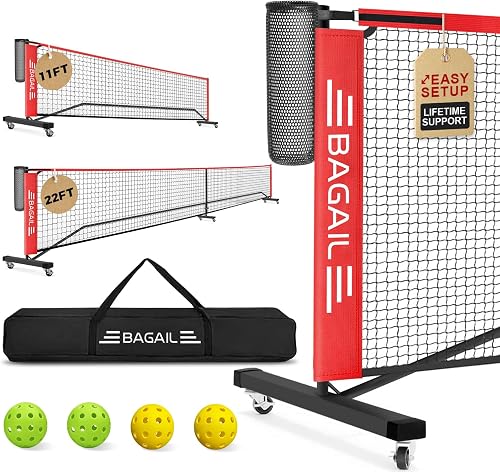
BAGAIL Portable Pickleball Net Set, 22 FT Regulation Size Pickle Ball Net with Ball Collector, 4 Balls and Carry Bag…
BAGAIL Portable Pickleball Net Set, 22 FT Regulation Size Pickle Ball Net with Ball Collector, 4 Balls and Carry Bag…

Franklin Sports Portable Outdoor Pickleball Net - Regulation Size 22' Foot Net with Travel Bag
PickleballPala score: combines the average rating and the number of buyer reviews on Amazon. No brand pays to be featured.
Regulation size to look for
A pickleball net stands 36 inches (91.4 cm) high at the sidelines and 34 inches (86.4 cm) at the center. That slight dip in the middle isn't a flaw: it's in the rulebook and rewards crosscourt shots. The net must be at least 21 ft 9 in (6.63 m) wide, and most regulation portable nets measure about 22 ft (6.7 m) post to post, so the posts sit outside the sidelines of a 20-ft-wide court.
Plenty of cheap nets are sold as "regulation size" when they aren't, or let you build a shorter version for kids and small spaces. Check the listing for the total width and make sure the center pole lets you set the height to 34 inches. For the rest of the court dimensions, see our guide to pickleball court dimensions.
Frame: steel or aluminum
| Material | Pros | Cons |
|---|---|---|
| Powder-coated steel | Heavier and steadier in wind; usually more affordable | More of a hassle to carry; can rust if the coating gets scratched |
| Aluminum | Light, rustproof, easy to move | More prone to tipping in wind if the base is narrow; costs a bit more |
| Thin steel tubing or fiberglass | Very light and cheap | Bends and lets the net sag; only for occasional play |
Beyond the material, look at tube diameter, leg shape (a wide H- or T-shaped base is more stable) and connectors: metal fittings outlast plastic ones. A good tensioning system, with straps or an internal cable, keeps the net from sagging over time.
Setup, wheels and carry bag
Mid-range portable nets go up in about 10 to 20 minutes the first time and in under 10 once you've got the hang of it. Shock-corded poles, like the ones on a camping tent, speed things up a lot. Premium nets add wheels or a folding design so you can roll them away almost fully assembled.
- Carry bag: a must; look for heavy fabric and reinforced handles.
- Wheels: very handy if you store the net far from the court or set it up and take it down every day.
- Weight: check the total weight; a 20-30 lb (10-15 kg) net is easy to haul, but not everyone wants to lug 45 lb (20 kg).
Tip: pair your net with a court marking kit and you'll have a complete court on any flat, smooth surface.
Where to set it up: tennis courts, padel courts and driveways
A single tennis court fits up to four pickleball courts, so one or more portable nets let you make better use of the space. A padel court (about 33 × 66 ft, or 10 × 20 m) fits one, although the walls shrink the safety zone. In a parking lot or driveway, look for a smooth, level surface and leave room around the court: the ideal total area is 30 × 60 ft (9.14 × 18.29 m).
Watch the wind: a portable net acts like a sail. In strong gusts it can tip over, especially lightweight aluminum frames with a narrow base. Weigh the legs down with sandbags if you play somewhere exposed, and don't leave it standing unattended.
Common mistakes when buying a net
- Trusting "regulation size" without checking width and height on the listing.
- Buying a badminton or kids' tennis net thinking it'll do: the height and width don't match.
- Picking the lightest net to play somewhere windy.
- Skipping the bag or leaving the net outside all winter: sun and moisture break down the mesh and straps.
To get your new court rolling, check out our outdoor balls. We compare spec sheets, the rulebook and verified reviews, but we don't physically test the products: always confirm dimensions and materials on the listing before you buy.
Frequently asked questions
How tall is a pickleball net?
36 inches (91.4 cm) at the sidelines and 34 inches (86.4 cm) at the center. Good portable nets include a center pole so you can set that height.
How wide is a portable pickleball net?
The rules call for at least 21 ft 9 in (6.63 m). Most regulation portable nets are about 22 ft (6.7 m) wide, so the posts sit outside the sidelines.
Is a steel or aluminum net frame better?
Steel is heavier and steadier in wind; aluminum is lighter, rustproof and easier to carry. If you play somewhere exposed, prioritize stability or weigh the legs down.
Can I set up a pickleball net on a tennis or padel court?
Yes. A tennis court fits up to four pickleball courts and a padel court fits one, though the walls reduce the safety zone. You just need to mark the lines.


