If you buy through our links, Amazon pays us a small commission at no extra cost to you. That’s how we keep the site running. How we choose.
Contents
Our top 3 picks
Stock checked on October 7, 2026


pickleball paddles comparison, in stock
niupipo Pickleball Paddles Set of 2 or 4, USAPA Approved Fiberglass Pickleball Paddle Set with Balls and Bag…
niupipo Pickleball Paddles Set of 2 or 4, USAPA Approved Fiberglass Pickleball Paddle Set with Balls and Bag…

niupipo Pickleball Paddles Set of 2 or 4, USAPA Approved Fiberglass Pickleball Paddle Set with Balls and Bag…
MTEN Pickleball Paddles Set of 2/4/1, USAPA Approved Fiberglass Rackets

MTEN Pickleball Paddles Set of 2/4/1, USAPA Approved Fiberglass Rackets

MTEN Pickleball Paddles Set of 2/4/1, USAPA Approved Fiberglass Rackets
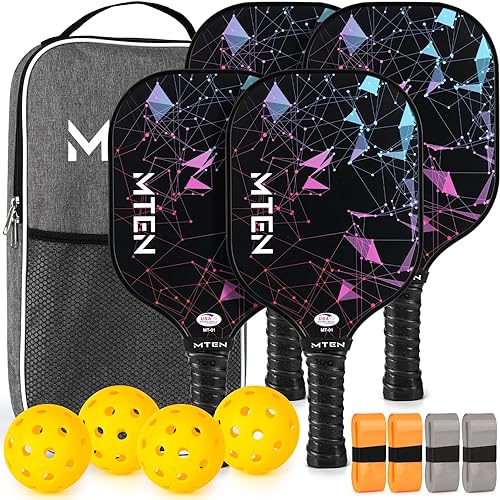
MTEN Pickleball Paddles Set of 2/4/1, USAPA Approved Fiberglass Rackets

JoncAye Pickleball Paddles Set of 4 or 2 Fiberglass Rackets USAPA Approved
PickleballPala score: combines the average rating and the number of buyer reviews on Amazon. No brand pays to be featured.
How to choose a pickleball paddle
Your paddle shapes your game more than any other piece of gear, and Amazon lists hundreds of models that look almost identical in photos. The real differences come down to four variables: weight, core, face material and shape. Once you understand them, you can rule out what does not suit you in minutes and compare just two or three sensible options.
Before looking at brands, answer three questions: How often do you play each week? Are you coming from tennis, padel or no racket sport at all? Do you have any elbow or shoulder pain? Someone who plays a couple of evenings a week does not need the same paddle as a player entering tournaments.
Weight: light, midweight or heavy
The rules do not limit weight, but nearly every paddle falls between about 7 and 9 oz. A fraction of an ounce makes a noticeable difference in the hand:
| Weight | Range | Pros | Cons |
|---|---|---|---|
| Light | under 7.3 oz (207 g) | quick hands at the net, less fatigue | less power, more vibration on off-center hits |
| Midweight | 7.3-8.3 oz (207-235 g) | balance of control and power | nothing major: the most versatile choice |
| Heavy | over 8.3 oz (235 g) | power and stability when blocking | more stress on elbow and shoulder, slower at the net |
When in doubt, go midweight. You can always add lead tape to gain a little weight, but you cannot take it off.
Core and thickness
Almost every modern paddle uses a polymer (polypropylene) honeycomb core: soft, quiet and good at soaking up vibration. Nomex is harder and louder, with a livelier pop, and aluminum shows up in some lightweight, control-oriented paddles.
Typical thickness runs from 13 to 16 mm (roughly 1/2 to 5/8 in). A 16 mm core gives more feel, more control and a steadier sweet spot, which is ideal for dinking at the kitchen line. A 13-14 mm core adds pop but is less forgiving. For most recreational players, 16 mm is the safe bet.
Face material: fiberglass, carbon fiber or wood
- Fiberglass: a slightly springier face that adds power with little effort. It is the base of many budget and mid-range paddles and a great way to start.
- Carbon fiber: stiffer, with better control and feel, and with "raw carbon" faces such as T700, more spin. See our carbon fiber paddles guide.
- Graphite: another form of carbon, very thin and light, with good touch.
- Wood: cheap, heavy and without a honeycomb core. Only worth it to try the sport for an afternoon or for schools.
Tip: if you are new, a midweight fiberglass or composite paddle with a 16 mm core is the most sensible starting point. Check our picks of beginner paddles.
Shape and grip size
USA Pickleball rules say length plus width cannot exceed 24 inches (60.96 cm), with a maximum length of 17 inches (43.18 cm). Within that limit there are three main shapes:
- Standard (about 16 x 8 in): the largest sweet spot and the easiest to handle.
- Elongated (about 16.5 x 7.5 in): more reach and power, but a smaller sweet spot. Popular with former tennis players.
- Widebody: a broad, very forgiving face that feels comfortable at the net.
Grip circumference usually runs from 4 to 4.5 inches (10-11.5 cm). If you are between sizes, pick the smaller one and build it up with an overgrip. A standard handle is about 5 inches (12-13 cm); longer handles make a two-handed backhand easier.
Which paddle to look for by player type
- New player or family games: a 2- or 4-paddle set with balls, or a midweight fiberglass paddle.
- Tight budget: look at budget paddles with a polymer core and skip wood if you plan to play regularly.
- Playing several times a week: carbon fiber, a 16 mm core and a standard or elongated shape depending on your style.
- Coming from padel: a pickleball paddle is lighter, has no holes and uses a shorter swing; start with a standard shape.
USA Pickleball Approved: do you need it?
For sanctioned play, your paddle must be on the USA Pickleball approved paddle list, which checks dimensions, a rigid surface with no holes, roughness and deflection. For casual games it is not required, but the seal is a good sign the paddle meets the rules. Look for the printed seal and, if you compete, check the exact model on the official list.
Common paddle-buying mistakes
- Buying the heaviest paddle "to hit harder": you lose hand speed at the net and punish your elbow.
- Spending on a premium paddle before you can control a dink.
- Choosing a grip that is too thick: it tires the forearm and limits wrist action.
- Relying on a wooden paddle as your main paddle.
Heads up: if you deal with tennis elbow or shoulder pain, avoid heavy paddles with thin cores, and read our injuries and warm-up guide. For a deeper dive, see how to choose a pickleball paddle.
We compare spec sheets, the official rules and verified reviews, but we do not physically test the products. Use the models above as a starting point and always confirm weight, thickness and dimensions on each listing.
Frequently asked questions
What is the best pickleball paddle?
There is no single best paddle: it depends on your level and style. For most recreational players, a midweight paddle (7.3-8.3 oz) with a 16 mm polymer core and a fiberglass or carbon fiber face in a standard shape works very well.
What paddle weight should I get?
When in doubt, go midweight, between 7.3 and 8.3 oz. Light paddles give quicker hands and less fatigue; heavy paddles add power and stability but put more stress on the elbow and shoulder.
Is fiberglass or carbon fiber better for a pickleball paddle?
Fiberglass gives more power with less effort and is usually cheaper, which makes it ideal for beginners. Carbon fiber is stiffer and offers more control, feel and spin, so it is the usual choice for players who play often.
Do I need a USA Pickleball approved paddle?
Only for sanctioned tournaments, where the paddle must be on the approved list. For rec play with friends or at your club it is not required, although the seal tells you the paddle meets the rules.


