If you buy through our links, Amazon pays us a small commission at no extra cost to you. That’s how we keep the site running. How we choose.
Contents
cheap pickleball paddles comparison, in stock

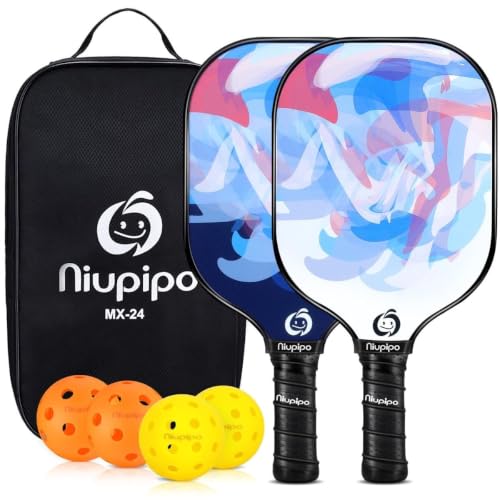
niupipo Pickleball Paddles Set of 2 or 4, USAPA Approved Fiberglass Pickleball Paddle Set with Balls and Bag…



What to expect from a cheap paddle
Budget paddles have come a long way. It is now easy to find paddles with a fiberglass face and a polymer honeycomb core, the same basic construction used in many mid-range paddles. For playing with friends once or twice a week, a well-chosen cheap paddle does the job.
What you gain is obvious: you spend little, you can buy two to play with a partner, and you do not worry much if it scrapes the court. What you give up is in the details: less feel and control on soft shots, a less consistent sweet spot, a thinner or slippery grip and finishes that wear faster.
Materials: fiberglass, wood and "budget carbon"
| Material | Pros | Cons |
|---|---|---|
| Fiberglass | Power, good value, polymer core | Less control and spin than carbon |
| Wood | Very cheap and hard to break | Heavy, little feel, tiring on the arm |
| Budget carbon | More control and feel if it is real | Often just a thin layer or cosmetic finish |
Fiberglass is the smartest choice at the low end: it gives easy power and forgives off-center hits. Wood only makes sense for trying the sport or keeping loaner paddles around: it is heavy and transmits a lot of vibration. Cheap carbon calls for caution: some budget paddles have a genuine carbon face and play well, while others say "carbon" because of a decorative film over fiberglass. If you really want carbon, see our roundup of carbon fiber paddles.
Durability: what usually fails first
On cheap paddles the most common failures are the edge guard peeling or cracking from scraping the court, the grip wearing out or getting slick within weeks, and the core softening until the paddle sounds hollow. Edge guard tape and a fresh overgrip extend its life for very little money.
Tip: look for a midweight paddle, 7.3 to 8.3 oz (207-235 g), with a core about 1/2 to 5/8 in thick (13-16 mm). It is the most balanced combination and the easiest on your elbow.
Red flags on a budget paddle
- A listing with no weight or dimensions, or numbers that differ between the photos and the text.
- Claims of "pro T700 carbon" with no close-up photos of the face.
- Wood paddles marketed as "lightweight": they almost never are.
- Reviews mentioning peeling edges, a rattling sound inside the paddle or cracks after a few sessions.
- Non-regulation dimensions: length plus width over 24 in (60.96 cm) or length over 17 in (43.18 cm).
Warning: if you hear or feel something moving inside the paddle when you shake it, the core has delaminated. Stop using it: the ball response becomes unpredictable and it may break.
When it is worth upgrading
If you play more than two or three times a week, join a league, or feel the paddle is holding back your drops and dinks, it is time to look at mid-range options. The same goes if you have elbow pain: a better-built paddle vibrates less. For families or groups of friends, another route is a pickleball paddle set that includes balls. And if you are unsure about weight, shape or grip size, read how to choose a pickleball paddle.
We compare spec sheets, the official rulebook and verified reviews, but we do not physically test products. Use the paddles above as a starting point and always confirm weight and materials on the listing.
Frequently asked questions
Is a cheap pickleball paddle good enough for beginners?
Yes. A budget fiberglass paddle with a polymer core is enough to learn and play for fun. Avoid wood if you plan to play often, because it is heavier and tires your arm.
Are cheap carbon pickleball paddles really carbon?
Some are, while others only have a thin film or carbon-look finish. Check close-up photos of the face, the weight and reviews before trusting the name.
How long does a budget pickleball paddle last?
It depends on how much you play. The edge, the grip and eventually the core are what usually fail first. Edge guard tape and a new overgrip extend its life considerably.
Is a wood or fiberglass pickleball paddle better?
Fiberglass is lighter, gives more power and transmits less vibration. Wood only makes sense as a loaner paddle or for trying the sport once.
You may also like
- ComparisonPickleball paddlesPickleball paddles compared for beginners and advanced players: fiberglass vs carbon fiber, weight and shape. See which one suits your game best.
- ComparisonPickleball paddles for beginnersYour first pickleball paddle, minus the mistakes: mid weight, 16 mm core and fiberglass face, with models in stock on Amazon. Compare and pick yours today.
- ComparisonCarbon fiber pickleball paddlesCarbon fiber pickleball paddles explained: what raw T700 carbon and thermoformed builds add, and when they beat fiberglass. Compare models and choose yours.
- ComparisonPickleball paddle setsPickleball sets with 2 or 4 paddles, balls and a bag: who they suit, what to check on paddle quality and when buying separately is smarter. Pick your kit.
- ComparisonPickleball edge guard tapeEdge guard tape for pickleball paddles: protects the rim from scuffs, how much weight it adds and how to apply it step by step. Make your paddle last longer.
- GuideBasic Pickleball Shots: Dink, Drive, Volley and Third ShotThe basic pickleball shots made simple: grip, return, drive, third shot drop, dink and volley, with a table of when to use each one and drills to practice.
- GuidePickleball Injuries and Warm-Up: How to Prevent ThemThe most common pickleball injuries (elbow, shoulder, ankle and falls) and how to avoid them, with an easy 10-minute warm-up routine before every game.
- GuidePickleball Court Dimensions: Official Size and Layout GuideOfficial pickleball court dimensions (20 × 44 ft), kitchen, net height and run-off space, plus how to lay one out on a tennis or padel court or at home.