If you buy through our links, Amazon pays us a small commission at no extra cost to you. That’s how we keep the site running. How we choose.
Contents
Our top 3 picks
Stock checked on October 7, 2026


kids pickleball paddles comparison, in stock
Kids Pickleball Paddle Set of 2 - Includes 2 Pickleball Paddles with 2 Balls, Lightweight, Fiberglass, Better Control…
Sportbit Kids Pickleball Paddles Set of 1 or 2 - Child Size Pickleball Paddle for Kids Small and Lightweight - Carbon…

Sportbit Kids Pickleball Paddles Set of 1 or 2 - Child Size Pickleball Paddle for Kids Small and Lightweight - Carbon…

Sportbit Kids Pickleball Paddles Set of 1 or 2 - Child Size Pickleball Paddle for Kids Small and Lightweight - Carbon…
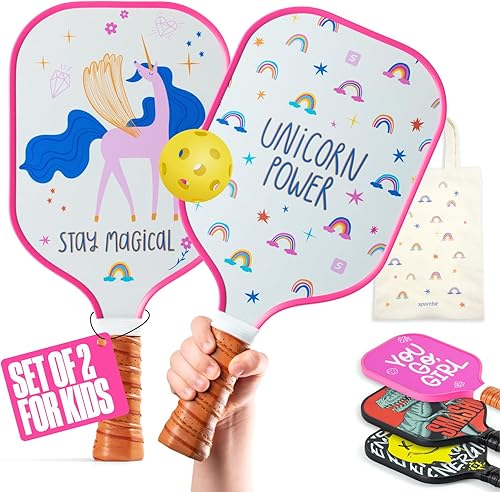
Sportbit Kids Pickleball Paddles Set of 1 or 2 - Child Size Pickleball Paddle for Kids Small and Lightweight - Carbon…

Sportbit Kids Pickleball Paddles Set of 1 or 2 - Child Size Pickleball Paddle for Kids Small and Lightweight - Carbon…
Kids Pickleball Paddle Designed for Ages 3–12 | Lightweight Fiberglass (0.37 lbs) | Small Grip for Easy Control | Fun…

Kids Pickleball Paddles (Set of 2), Child Size Paddles, Lightweight Honeycomb Core, Fiberglass Strike Face, 2 Youth…
PickleballPala score: combines the average rating and the number of buyer reviews on Amazon. No brand pays to be featured.
Why kids need a different paddle
Pickleball is one of the easiest racket sports for kids to pick up: the court is small, the ball moves slowly and the serve is underhand. An adult paddle can still get in the way, though. If it is too heavy, the child holds it with a bent wrist and tires quickly; if the grip is too thick, they cannot close their hand around it and lose control.
Kids or "junior" paddles fix this with less weight, a thinner handle and sometimes a slightly smaller face. There is no official junior size: the rules only set a maximum (length plus width of 24 in, or 60.96 cm), so each brand defines its own sizing.
What to look for in a kids paddle
Weight
For most kids, a paddle in the lightweight range, under 7.3 oz (207 g), is the right call. The younger the child, the more it matters. A simple check: if they can hold it at arm's length for a few seconds without the tip dropping, the weight is reasonable.
Grip size
A standard adult grip is 4 to 4.5 in around (10-11.5 cm). Kids usually need the smallest grip available or a dedicated junior model. A small grip can always be built up with an overgrip; a thick one cannot be made smaller.
Material: wood or composite
Wood paddles are cheap and nearly indestructible, but they are also heavy, which is exactly what a child does not need. Composite paddles (fiberglass with a polymer core) weigh less, vibrate less and send the ball over the net with little effort. If your child will play more than a handful of times, composite is worth it.
| Approximate age | What to look for | Recommended ball |
|---|---|---|
| Up to about 8 | Very light junior paddle, small grip, bright colors | Indoor, softer and slower |
| 9 to 12 | Light composite paddle, smallest adult grip or junior | Indoor or outdoor depending on the court |
| Teens | Light or midweight adult paddle | Same as adults |
Ages are only a guide: a child's height and strength matter more than the number of birthdays.
Tip: bright colors and fun designs are not a small thing. A kid who is proud of their paddle plays more. If the whole family plays, a pickleball paddle set that includes lighter paddles can be better value than buying singles.
Safety on the court
Pickleball is a safe sport, but kids play close together and do not yet control direction well. Protective eyewear prevents scares from balls to the face, especially at the net. Also check that the paddle has no peeling edges or splinters (on wood models) and that the grip is not slippery. Court shoes or sneakers with good soles complete the gear.
Warning: avoid giving a young child a heavy adult paddle "to grow into." Straining the wrist and elbow with an oversized paddle can cause aches and quickly kills their interest in the game.
How kids learn to play
Start with simple games: bouncing the ball on the paddle, rallying without a net, then playing half-court near the net with soft dinks. After that, introduce the underhand serve, the two-bounce rule and the kitchen. To explain the rules simply, our guide what is pickleball and how to play is a good starting point, and the one on the kitchen rule clears up the rule kids find trickiest at first.
Common mistakes when buying a kids paddle
- Buying a heavy wood paddle just because it is cheap.
- Choosing the grip for looks instead of hand size.
- Giving young kids hard outdoor balls in a gym: they bounce faster and are harder to control.
- Buying a pro-level carbon paddle: at that age it adds nothing and usually weighs more.
We compare spec sheets, the official rulebook and verified reviews, but we do not physically test products. Use the paddles above as a starting point and always confirm weight and grip size on the listing.
Frequently asked questions
What age can kids start playing pickleball?
Many kids can start around age 6 with a light paddle and soft indoor balls. More than age, what matters is that the paddle is not too heavy and the first games are simple.
How much should a kids pickleball paddle weigh?
Aim for the lightweight range, under 7.3 oz or 207 grams. If your child can hold it at arm's length without the tip dropping, the weight is about right.
Wood or composite paddle for a child?
Composite, meaning fiberglass with a polymer core, is lighter and vibrates less. Wood is cheaper and tougher, but heavier and more tiring.
Can a child use an adult pickleball paddle?
A teenager can, if it is a light one. For younger kids, a junior paddle or the lightest adult paddle with the smallest grip you can find is the better choice.


