If you buy through our links, Amazon pays us a small commission at no extra cost to you. That’s how we keep the site running. How we choose.
Contents
Our top 3 picks
Stock checked on October 7, 2026

pickleball court line kits comparison, in stock
Court Line Marker Set Create Your Own Mini Pickleball Tennis Court (Yellow Line)
Pickleball Court Tape, 2 in x 262 ft, Temporary Marking

Pickleball Court Tape, 2 in x 262 ft, Temporary Marking

Pickleball Tape for Outdoor Court, Temporary Pickleball Court Tape

Pickleball Tape for Outdoor Court, Temporary Pickleball Court Tape
Franklin Sports Pickleball Court Marker Kit - Lines Marking Set with Tape Measure - Official Size Court Throw Down…

Court Line Marker Set Create Your Own Pickleball Mini Tennis Court

Court Line Marker Set Create Your Own Pickleball Mini Tennis Court
PickleballPala score: combines the average rating and the number of buyer reviews on Amazon. No brand pays to be featured.
Why use a line kit
Dedicated pickleball courts are still scarce in many towns, so most people play on a tennis court, in a school gym or on a multi-use slab. The existing lines belong to another sport and only confuse things. A line kit lets you lay out a court in ten to fifteen minutes, play, and leave everything as you found it. Paired with one of the portable pickleball nets, it is the cheapest way to get a group going at your club or local park.
Marking options: tape, throw-down lines and chalk
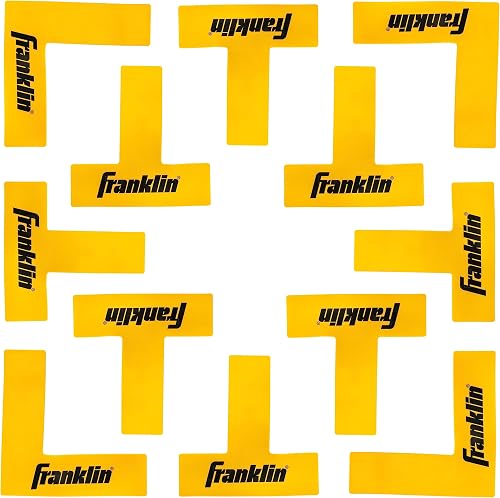
- Throw-down rubber or PVC lines: flat strips with corners and T-pieces that sit on the surface with no adhesive. They go down and come up in minutes, work on almost any surface and leave no trace. On the downside, they can shift when kicked or in the wind, and some curl in hot sun.
- Removable tape: 2-inch (5 cm) vinyl or painter's-style court tape. It lies perfectly flat and looks sharp, great for a few weeks on hard courts or gym floors. Check that the adhesive won't lift the court coating.
- Chalk or temporary paint: spray or powdered chalk is cheap and washes away with rain or a hose, ideal for one-day events. Permanent paint only makes sense with written approval from whoever owns the facility.
| System | Setup | Lifespan | Best surface |
|---|---|---|---|
| Throw-down lines | 10-15 min, no adhesive | Years (reusable) | Concrete, acrylic, gym floor, short grass |
| Removable tape | 30-45 min | Days to weeks | Smooth hard court, gym floor |
| Chalk | 15-20 min | One session | Outdoor asphalt and concrete |
Dimensions to mark
The court is 20 × 44 ft (6.10 × 13.41 m) for both singles and doubles. The kitchen, or non-volley zone, extends 7 ft (2.13 m) from the net on each side, and each service area is 15 ft deep by 10 ft wide (4.57 × 3.05 m). Lines are 2 in (5 cm) wide and count as part of the court, so measure to the outside edge of each line. Everything is laid out in our guide to pickleball court dimensions.
Tip: to make sure the court is square, measure both diagonals. Each should be about 48 ft 4 in (14.73 m). If they don't match, shift one corner until they do.
Lining a tennis, padel or multi-use court
A tennis court can hold up to four pickleball courts, though starting with one or two using a lowered tennis net or a portable net is easier. A padel court (about 33 × 66 ft, 10 × 20 m) fits one court, but the glass walls eat into the run-off behind the baseline, so play with care. A padel net is slightly taller in the middle than a pickleball net (34 in, 86.4 cm), so bring your own. Curious about the difference between the sports? Read pickleball vs padel.
Pick a color that contrasts with the surface and the existing lines: orange or yellow on a blue court, white on green. That way nobody argues about whether a ball landed in.
What clubs and parks departments allow
Ask before you stick anything down. Many clubs are fine with throw-down lines because they don't touch the surface, but ban tape on freshly coated acrylic, on clay or on padel turf, where it won't stick anyway. On public courts, permanent paint always needs approval from the parks department or city.
Common mistakes
- Measuring to the center of a line instead of its outside edge.
- Using packing tape, which leaves residue and peels in the heat.
- Forgetting the centerline that splits the service areas.
- Leaving throw-down corners lifted: they are a tripping hazard.
Warning: remove tape within the time the manufacturer recommends. Left too long in the sun, the adhesive bakes on and can pull up the court coating.
You'll find more gear for your setup in our nets and court section. We compare spec sheets, the rulebook and verified reviews, but we do not physically test the products.
Frequently asked questions
What are the dimensions of a pickleball court?
A pickleball court is 20 by 44 feet (6.10 by 13.41 m) for singles and doubles. The kitchen extends 7 feet from the net on each side, and the 2-inch lines count as part of the court.
Can you line a pickleball court on a tennis court?
Yes. A tennis court can hold up to four pickleball courts. Throw-down lines or removable tape in a contrasting color are the easiest option, but get permission from the club or parks department first.
Is court tape or throw-down lines better?
Throw-down lines are better if you set up and take down every session, since there is no adhesive and they last for years. Tape lies flatter and looks sharper for a few weeks on a smooth court, but it must come up on time.
Does a pickleball court fit on a padel court?
One court fits, since a padel court is about 33 by 66 feet, but the walls shorten the run-off behind the baseline. Use a portable pickleball net, because a padel net is slightly taller in the center.


